
Powder coating vs wet paint – choosing the right finish for your project
C&O Powder Coatings » Powder coating vs wet paint – choosing the right finish for your project
Choosing the right coating and finish for a project can be a balancing act between cost, durability, and aesthetics – which is why we’re regularly asked about the difference between powder coating vs wet paint. It’s fair to say that both options protect the metal surface and look good when first applied, but it’s time where the real difference shows.
In our latest article we’re looking at both processes, seeing how they compare, and outlining how to choose the right finish for your project.
What are the differences between paint and powder coating?
Powder coating and wet paint both protect metal. Powder coating is a dry process where a fine powder is bonded to the aluminium whereas wet paint uses liquid solvents. The method you choose affects how the finish performs, how long it lasts and how much it costs to maintain over time.
Powder Coating
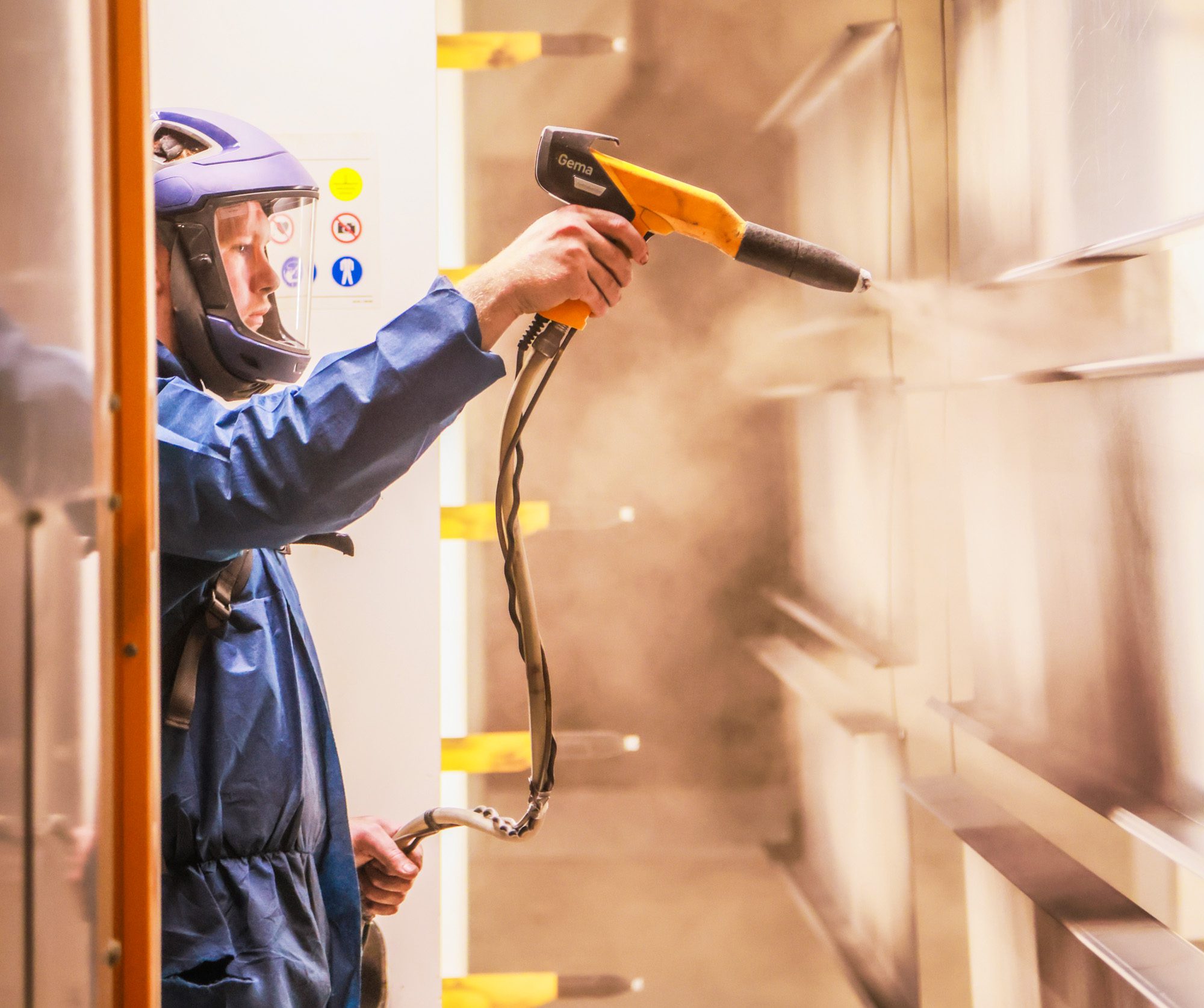
With powder coating fine particles of coloured polyesters, acrylics, or polyurethane are sprayed onto electrostatically charged aluminium making them to cling to the metal. When the desired thickness of coating is achieved it is then heated in an oven which melts the powder and chemically bonds it to the substrate. Once cured, which generally takes about 10 minutes, it creates a uniform protective coating over the metal which can be immediately handled and be ready for installation.
Wet Paint
Paint is generally made up of coloured pigments suspended in a solvent. Once sprayed on the metal the solvent begins to evaporate and harden to create a protective film. Depending on environmental factors and thickness of coating the paint can take up to 24 hours before it has hardened enough to be handled and 14 days to fully cure when it will be ready for installation.
Durability and Performance
Powder coating produces a finish that’s typically three to five times thicker than wet paint, and that additional thickness, combined with the chemical bond formed during curing, gives it a significant advantage in everyday performance.
Key differences between the two finishes are most apparent in:
Corrosion and Weather Resistance
Because powder coating forms a continuous barrier that protects the metal from moisture, salt, pollutants and UV light resistance it is significantly better when compared to wet paint. Also using Qualicoat Seaside certified pre-treatment doubles the etch depth to 2g/m², removing more contaminants from the metal and creating a more stable substrate for the coating to bond to.
Colour and Gloss Retention
Powder coating consistently outperforms wet paint, particularly in environments with higher UV exposure. Painted surfaces tend to chalk and fade after several years whereas powder coating will hold its original appearance for significantly longer.
Resistance to Wear and Damage
During installation cladding panels, rainscreen systems and other facade components are handled multiple times between the factory and the building, and the thicker, chemically bonded powder coating film is far less likely to chip or scratch during that process.
Consistency
Something we are regularly asked about is the consistency of colour and finish. This is something we pay particular attention to and is part of our TQM processes. Because the powder is electrostatically applied we can ensure a uniform thickness and appearance across batches which is essential for projects delivered in phases or where panels sit alongside each other on a façade.
When wet paint is the right choice
We’re slightly biased towards powder coating but there are situations where wet paint is the more practical option.
Wet paint can be mixed to make a wider variety of colours than powder coating which makes it a versatile solution where colour matching is required, for touch ups, where a component cannot be heated, or only a thin coating is required.
Where paint falls short is in environments that require long term performance such as in coastal locations exposed to the elements or on industrial sites.
Cost
Paint is generally a much cheaper option at first glance because it has a lower initial cost but understanding the cost difference between the two coatings is not just a matter of a cost per m2.
There are several factors which need to be considered including:
- How long is the expected life – paint will require repainting every five to ten years whereas powder coating will generally last 25 years or more.
- How accessible is the component – is it going to be installed high on a building where maintenance teams can’t access it easily for maintenance and repair.
- Are there environmental factors to the project – paint uses volatile organic compounds (VOCs) where the solvent evaporates during painting and is also hazardous if inhaled requiring specialist PPE during application. At C&O we stopped using hexavalent chromium in our pre-treatment process over 12 years ago and now use chrome free alternatives and there is very little waste from the powder coating process as overspray can be collected and reused.
- Wear and tear – paint can wear off and be more easily scratched or damaged meaning repainting is required more often.
Choosing the right finish
When deciding what finish is best for your project C&O have over 40 years practical experience in the industry so when we talk to customers we ask the following questions:
- What’s the installation environment? Coastal locations, industrial sites and areas with high pollution or UV exposure place greater demands on a finish.
- How long does it need to last? If your component is designed to last then the coating should too.
- How accessible will it be when installed? If accessibility is a problem you need a finish that requires little or no maintenance.
- Is refurbishment likely at some point? Powder coating is easier to manage over successive maintenance cycles because there’s no layer buildup. Wet paint accumulates and becomes progressively harder to remove over time.
At C&O we’ve seen the consequences of both good and poor specification decisions and our team is on hand to help specifiers and fabricators make the right choice for their project.
If you’d like to discuss which finish is right for your next project, contact our technical team at www.candocoatings.co.uk.